
Paper 07
Mangalā for the Modern World: Ancient Wisdom for Inner and Outer Peace
Abstract
This research aims to reintroduce the first six guiding principles of the Mångala Sutta as a practical and accessible framework for cultivating inner peace and outer peace for ordinary people and children in the modern world.
The six selected principles are: avoiding fools, associating with the wise, honoring thoses worthy of respect, living in a suitable environment, having past meritorious deeds, and setting oneself on the right path. These are not merely theoretical or monastic teaching but are intended as daily guidelines that busy individual, especially parents struggling with livelihood, children overwhelmed by modern education, and people constantly exposed to technological and social pressures.
The central arguments of this paper, that understanding and practicing these six principles at the individual level can lead to personal inner peace. From there, such peace can gradually radiate outward form the individual to the family, then to the community, and eventually to wider society, thereby contributing to genuine outer peace.To support this argument, the study draws upon and connects textual evidence form the Buddha’s teachings. These texts provide both doctrinal support and narrative illustrations that reinforce the relevance and effectiveness of these teachings. Methodologically, this paper employs both descriptive method and evaluative method. This study is presented purely social perspective, aiming to bridge the gap between ancient Buddhist wisdom and the everyday realities or modern families.
Ultimately, this research seeks to demonstrate that the Mångala Sutta is not outdated religious text, but a timeless, practical guidelines for anyone seeking peace starting from within and extending outward to create a more harmonious world.
Key Words: Ancient Wisdom, peace, guidelines, radiate
Introduction
The Mångla Sutta was taught by Gautama Buddha over 2600 years ago, for human beings to live in social harmony and ger at inner and outer peace. This sutta is one of the well- known Buddha’s teachings, contain Khuddakanikāya khuddaka, pātha. The Buddha taught thirty- eight guidelines.
At the present time, most people are encountering modern lifestyle, technological pressures, difficulties of livelihood and educational stresses. For the reasons, I would like to reintroduce the first basic six guidelines of the Mångala sutta and then by understanding and practicing, they get at social harmony and inner and outer peace their world 1.
Though several scholars argued the Mångala sutta with perspective views, in this paper only the first six guidelines are argued/ proposed. They are;
- Asevanā ca bālānaṃ– avoiding fools
- Paṇḍitānañ ca sevanā – associating with the wise
- Pūjā ca puja neyyānaṃ – honouring those worth of respect
- Pațrūpa desa vasoca – living in a suitable environment
- Pubbe ca kata puññatā – having a past meritorious-deeds
- Attasammā paṇidi ca _ setting oneself on the right path
Asevanā ca bālānaṃ– avoiding fools
Who are foolish persons? “Those who do evil and bad deeds actions, are likewise their own enemies and they walk around” Khuddaka pātha Pāli, (Myanmar translation), (22-23). In five hundred and fifty Jātakanipāta, Mahā Sutasoma Jātaka, the king Bhymadat associated with a foolish.
1. world- five aggregates
person, “Rasaka” as he gave up his country and became a flesh-eater.
Paṇḍitānañ ca sevanā – associating with the wise
Who is a wise man? “A wise person should not do evil and bad deeds for his own sake or for the sake of others, should not desire his children, wealth or country out of greed. Such a person-virtuous, he is a wise man. Khuddaka Pātha Pāli, (Myanmar Translation), (24-25). Maha Sutasoma Jataka, a flesh- eater “Porisara” regain as a king of Barana because of Boddhisatta, Mahā Sutasoma’s teachings. It is a consequence of associating with the wise man. In addition, Porisara wholly gave up fresh- meat and he kept five precepts.
Pūjā ca puja neyyānaṃ – honouring those worth of respect
- “Pujā ca pujaneyānam” means to pay respect and honour to those who are worthy of respect. By offering to those who are worthy of respect in the world, one increase one’s knowledge. Nandamālā Bhivansa, A. (PhD), (4-5)
Pațrūpa desa vasoca – living in a suitable environment
- A kite didn’t live in a proper place for himself, consequently he died as his check was struck against the hard mud. The skylark lived in a right place for him, consequently he won the kite, more powerful than him. In addition, he was free from danger and alive, and also get at peaceful life. Mahā Vagga Samyutta Pāli (Myanmar Translation), (132-133)
Pubbe ca kata puññatā – having a past meritorious-deeds
“A person who has done good deeds in the past, whether in human life, monk life or deva life, is superior in the five things of life, appearance, wealth, honour, and government.” Ånguttor Pāli (Myanmar Translation), (35-38).
Attasammā paṇidi ca _ setting oneself on the right path
Through setting oneself on the right path, Ashin Pandita get at bodily and mental- tranquillity. Pandita novice who was a student of Ashin Sariputtara, saw the men who were making ditch, designing wood and arrows. He thought non-alive water, wood and arrows can be control as our desire, why didn’t control my mind to attain bodily and mentally tranquillity. He practiced his mind free from enemies _ lobha, dosa and moha. Finally, he attained authentic peace (Arahant). Dhammasāmi Bhivansa, A. (April 2007).
If those people who understanding and practicing these guidelines can achieve social harmony in their community every day. At the individual level lessen greed (lobha), hatred (dosa), and delusion (moha) and then can lead to inner peace (mental tranquillity) and outer peace (physical tranquillity). Thereby, through community radiate peace. Ultimately, include one by one world community can get at peace and social harmony.
Methods
Nowadays, as their lifestyle everybody needs to reduce the stresses and to enhance self-awareness. Among the Buddha’s teachings the M.S2 is very basic principles for everyone and to know easily as the Mångala verses, likes “avoiding fools and associating with the wise and then honouring those worth of respect” Tejavanta.A(2024), (63).
This paper employed descriptive and evaluated methods, in additionally textual qualitative research design. Initially, the author sought primary sources and secondary sources at the library of University of Global Peace and the internet websites.
The data were collected mainly from Pāli canons and Pāli canons (Myanmar Translations) and on occasion she used online sources (Wikipedia) to find out secondary sources just like Jātakanipāta. She discussed and asked some questions that are she did understand well, to 2.M.S- Mångala Sutta
, her teachers. And then, analysed the collected data, the following results and discussions were produced. Translation in this paper mainly on translation of her original Burmese text, some are translated with the health of scholars at Oo Yin monastery and University of Global Peace.
Findings
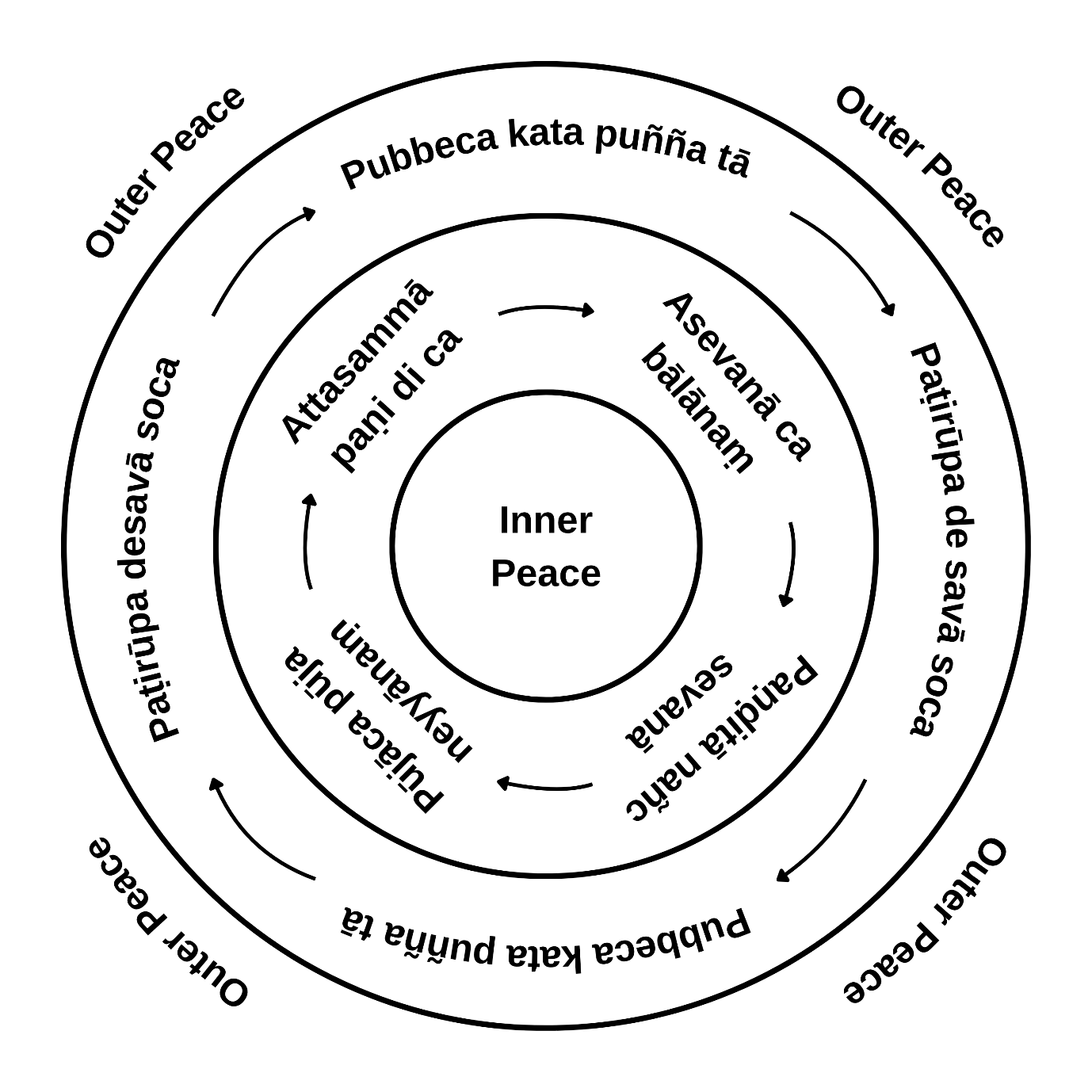
The first six guidelines in Mångala Sutta are interconnected with each other. By avoiding fools, reinforce to associate with the wise man. Conversely, associating the wise man can lead to avoid foolish person. And also, avoiding fools and associating the wise man can lead to set oneself on the right path. Conversely, setting oneself on the right path can understand that must avoid person is fools and associated person is the wise man.Because of not associating with fools, that person not acts bad deeds (unwholesome) while associate with the wise man, that person can practice good deeds (wholesome)_ non-greed, non-hatred and non-delusion.
If a person who has past meritorious deeds, he/she will meet the wise man and can feel peace through mind and body. A person who selects and lives in right environment, will get the supports the rest of five guidelines. According to analysis, through understanding and practising the first six guidelines in Mångala Sutta, any layperson can get at inner peace (mental tranquillity) and outer peace (social harmony) in daily life. The causation between these six guidelines can be connect the following expression.
The Expression of Inner and Outer Peace
Discussions
Every bad action base on associating with foolish person, thus avoiding fools is the most crucial point for everybody. Those persons who follow this point others good actions will come out consequently. According to avoid fools, those who do not act unwholesome. Greed (lobha), hatred (dosa) and delusion (moha) are unwholesomes which can cause suffering then lead to evil after death. Associating with the wise, the person who does not do evil his own sake or the sake of others, that person will be full wholesomes. Non-greed (alobha), non-hatred (adosa), and non-delusion (amoha) are wholesomes which support pleasant and achieve balminess. They can assist free from suffering, ultimately to attain Nibbāna.
Likewise improve wisdom through associating wise man. The knowledgeable persons do good actions _ paying respect to triple gems, do donations keep precepts, and also do meditation. The knowledgeable person can decide correct social, economic, health, and education as a result of associating with the wise. As a result of having a past meritorious good-deeds, that person obtains right environment consequently meets the wise man. Through listening right speak from the wise man, the layperson sets up himself /herself correctly. He/ She also then practices good deeds for next life.
If a person who understands, and practice the first six basic guidelines, he /she diminishes greed, hatred, and delusion, coincides non-greed, non- hatred, and non-delusion appears. Because of these, he/she feels peace mind and body. It is individual inner and outer peace.Thus, small community a family contains one by one and village, city-state, and then the largest community world can radiate peace. This six blessedness are the authentic peace guidelines taught by the Buddha. The rest thirty- two guidelines which are not included in this paper, through good ethics and insight meditation can attain Nibbāna. Otherwise, any scholar continues study and research the rest guidelines, can find out the deep wisdom.
References
Aṅguttara Pāli (Myanmar translation). (2019) Ministry of Religious Affairs, Department of Religious Affairs, Kabar Aye Press.
Abhidhammattha-vibhāvinī ṭīkā. (1995). Ministry of Religious Affairs, Department of Religious Affairs, Kabar Aye Press.
Dhammasāmi Bhivansa, A. (April 2007). (3rd ed). The Illustrated Book of Dhamma Pada Vutta. Yangon. Khin Cho Tun.
Khuddaka Nikāya, Khuddaka pāṭha (Pāli). (2019). Ministry of Religious Affairs, Department of Religious Affairs, Kabar Aye Press.
Khuddaka pāṭha (Myanmar translation). (2019). Ministry of Religious Affairs, Department of Religious Affairs. Kabar Aye Press.
Saṃyutta Pāli (Vol. 3). (2019) (Myanmar translation). Ministry of Religious Affairs, Department of Religious Affairs. Kabar Aye Press.
Nandamālābhivaṃsa, A. Aggamahā Panḍita, PhD. (n.d.). Summary of the great (11) suttas.
Nyaung Kan Sayardaw,V.(Mingalar Bon Kyaw). (1995). Five- Hundred and Fifty Illustrated Stories Jarakanipata. Maha Sutta Soma Jātaka (537.5)
Tejavanta, A. (2024). The Buddha’s ethic. Monastic Education Centre No. 1, Amarapura, Mahar Gandar Yone Monastery.